
Metro lines, ring roads, malls: how to read government infrastructure announcements before you buy plots or sites in North Bangalore, stage by stage.
Every few weeks a headline promises to transform a corner of Bengaluru: a new metro line, a ring road, a second airport, a revised master plan. Some of these announcements reshape neighbourhoods for a generation. Others remain on paper for years. Knowing the difference is one of the most valuable skills a property buyer can have.
This guide offers a practical way to read infrastructure and policy news, using real North Bangalore examples from 2025 and 2026.
The five stages of an infrastructure project
Almost every public project passes through the same stages. The further along it is, the more weight it deserves in your decision.
- Announcement. A minister, budget speech or press release names the project. Useful as a signal of intent, but nothing more.
- Detailed project report (DPR) and approvals. Alignment, cost and funding are worked out and approved by the state or central government.
- Funding and land acquisition. Money is allocated or borrowed, and land is acquired. Projects often stall here.
- Tender and construction. Contracts are awarded and work begins on the ground. Now the project is real, even if timelines move.
- Operation. The road opens, the trains run. Its effect on the neighbourhood is fully visible.
North Bangalore projects, by stage (October 2026)
- Operating: Satellite Town Ring Road, Dobbaspet–Devanahalli–Hoskote (80 km); Kempegowda Airport Terminal 2
- Under construction: Namma Metro Blue Line to the airport, reported 72% complete in August 2026
- Tendered: Bengaluru Business Corridor (former Peripheral Ring Road), Phase 1 global tenders floated March 2026
- Planned and funded: Suburban rail, with ₹500 crore in the 2026–27 state budget and a December 2030 target
- Undecided: Bengaluru’s second airport; no site finalised
Read the verbs
The language of an announcement tells you where a project stands. “Proposed”, “planned”, “under consideration” and “mooted” mean the project has not yet secured approval or money. “Sanctioned”, “approved by cabinet” and “funds allocated” are stronger. “Tenders floated”, “contract awarded” and “work under way” are stronger still. A headline that says a project “will transform” an area tells you nothing about which stage it has reached.

Follow the money
Budget documents are more reliable than speeches. When Karnataka’s 2026–27 budget allocated funds to suburban rail and set out new metro kilometres for the year, that was a concrete commitment. When a project appears only in a speech or a vision document without a budget line or a named funding source, such as a loan from a lender like HUDCO, treat it as an aspiration.
Check the ground
The simplest test is also the best: is anything happening on site? Metro pillars rising along the airport highway, land boundaries being marked for a road, survey teams at work. These are signs that a project has crossed from intention into execution. A site visit, or even a recent satellite image, can tell you more than a dozen headlines.
An announcement is a promise. A pillar in the ground is a fact.
Expect timelines to move
Large Indian infrastructure projects routinely open later than first announced. The airport metro was once targeted for mid-2026; current estimates point to the Hebbal–airport section in 2027 and the full line by early 2028. That does not make the project less valuable, but it does mean a sensible buyer never builds a decision around a single opening date.
Policy announcements: read the notification, not the headline
Changes to land rules, registration fees or guidance values only take effect when they are formally notified in the official gazette. In 2025 and 2026, for example, Karnataka doubled the property registration fee from 1% to 2% (effective 31 August 2025), introduced a time-bound scheme to convert B-Khata sites to A-Khata, and reportedly considered a revision of guidance values. The first two were notified and in force; whether and when the last applies should be checked on the state’s Kaveri portal before any calculation. When a policy affects your purchase, ask your lawyer for the notification number and its effective date.
Know who decides
Bengaluru’s governance changed significantly in 2025, when the Greater Bengaluru Authority was constituted with five city corporations. Around the airport, the Bangalore International Airport Area Planning Authority (BIAAPA) prepares the master plan and approves layouts. Knowing which body has authority over a project, or over the land you are considering, helps you judge whose announcements actually carry weight.
How we apply this to our plots
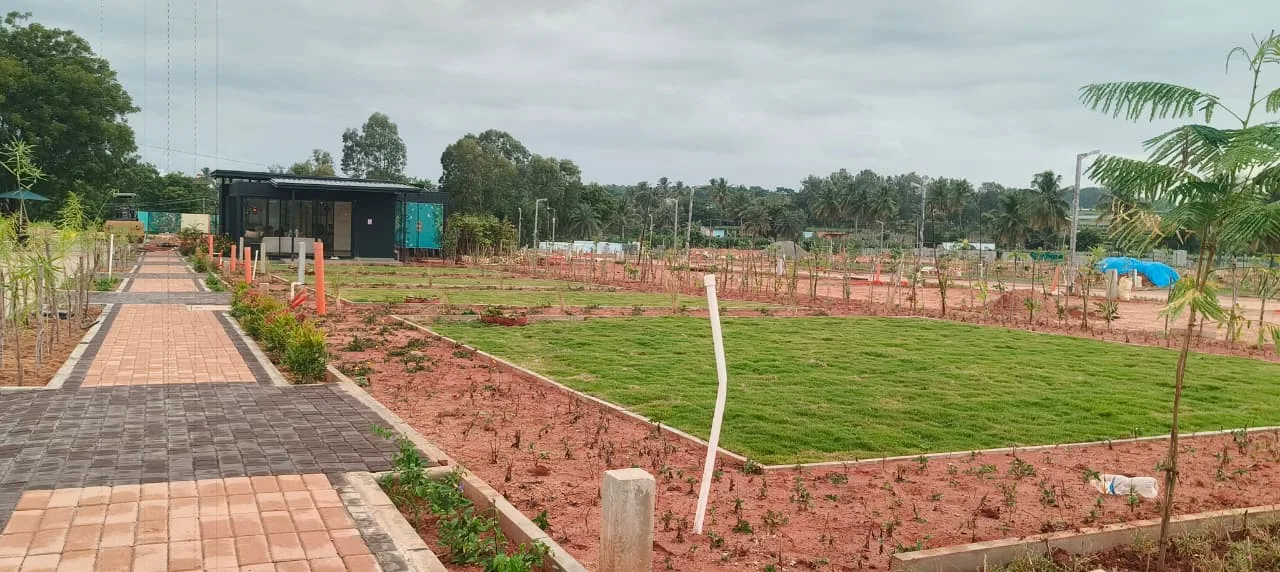
At Earthenhues Estates, we encourage buyers to value Lake Botanica for what is already true: BIAAPA approval, RERA registration, clear title, infrastructure in place and a location among established universities, schools and business parks. The airport metro, the Forum mall and the region’s new roads are meaningful upsides, and we describe them as exactly that. You can read more in our airport metro explainer and plot buyer’s checklist.
Project statuses are as publicly reported in October 2026 and may change.
Questions about infrastructure and land prices
How do new infrastructure projects affect land prices in Bangalore?
How can I check if a government infrastructure project is really approved?
Should I buy land based on a proposed project?
Sources
- Swarajya: Satellite Town Ring Road progress
- Business Today: Airport metro 72% complete
- Swarajya: Blue Line phased opening
- ETV Bharat: Bengaluru Business Corridor tenders
- The News Minute: Karnataka Budget 2026 for Bengaluru
- The South First: Second airport site
- Angel One: Karnataka registration fee hike
- The Week: Greater Bengaluru corporations notified